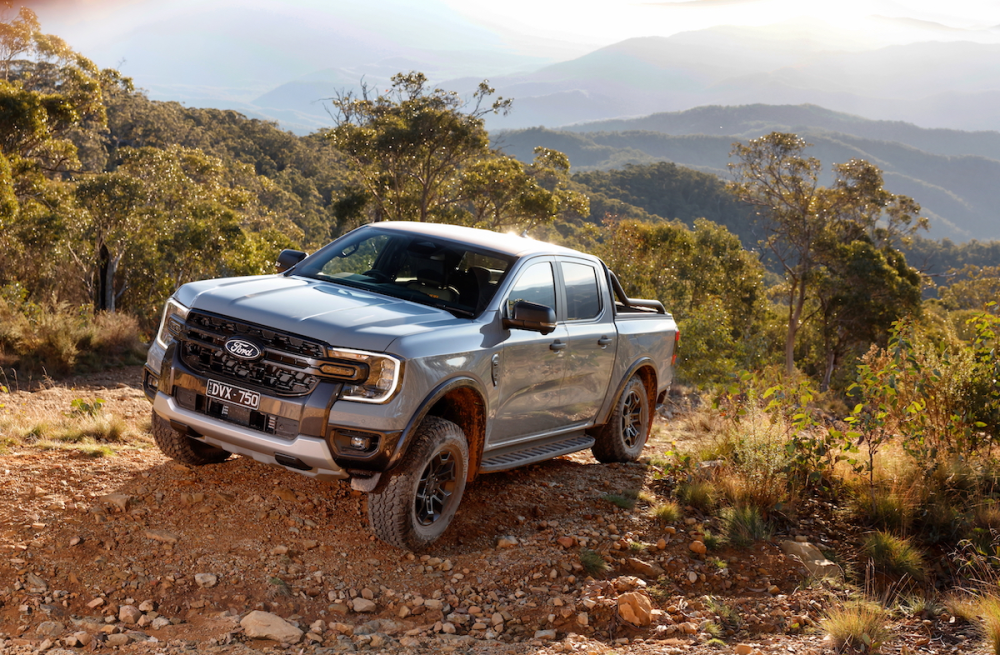
Driven: the MY26.5 Ford Ranger lineup
Ford continues to tweak the Ranger to keep it feeling fresh, along with addressing customers’ demands. That’s where this MY26.50 update comes in – a clunky way of noting a mid-year update, but one that has a lot of impact for entry-level buyers.
Many of those are the sort of people who rely on the reliability of their utes, which we’ll touch on later. Priced from $37,130 before on roads for an entry-level XL 4x2 and stretching all the way to $90,690 for the hardcore Raptor, there’s practically a Ranger for just about everybody.
You’d sure hope so with 15 possible specifications to choose from – and that’s excluding the beefed-up Super Duty. To sample the revised lineup, focusing solely on diesel variants, Ford invited us to the company’s You Yangs Proving Ground in Victoria.
Not only is this facility the only one of its kind in the southern hemisphere in terms of the facilities and equipment it has, but it’s also where the T6 platform that underpins the Ranger and Everest was developed.
Headlining the changes for this MY26.5 update is the introduction of a revised 2.0-litre four-cylinder single-turbo diesel engine. Replacing both the single and twin-turbo four-pots of before, this lone four-cylinder option has ditched the controversial wet timing belt.
In its place is a conventional timing chain, the changeover in direct response to customer feedback. Offering 125kW and 405Nm, it features a new fuel injection system aimed at improving economy. It’s fitted with a 10-speed automatic in place of the previous single-turbo model's six-speed.
As for the 3.0-litre single-turbo V6 diesel, that remains unchanged, with outputs of 184kW/600Nm and availability across the lineup, sans Raptor. Ford has confirmed that both diesel engines are capable of running on ‘HVO’ renewable diesel.
In terms of the Ranger lineup itself, strong customer response to special edition variants leads the biggest changes. The Black Edition is back, now with both engine options available, while the Tremor V6 has also returned for a limited time.
There’s also a new Wolftrak variant, another V6-only proposition adorned with a mix of light and dark green highlights. At the launch, most of our time behind the wheel of the Ranger was spent in the Black Edition spread across both engine options.
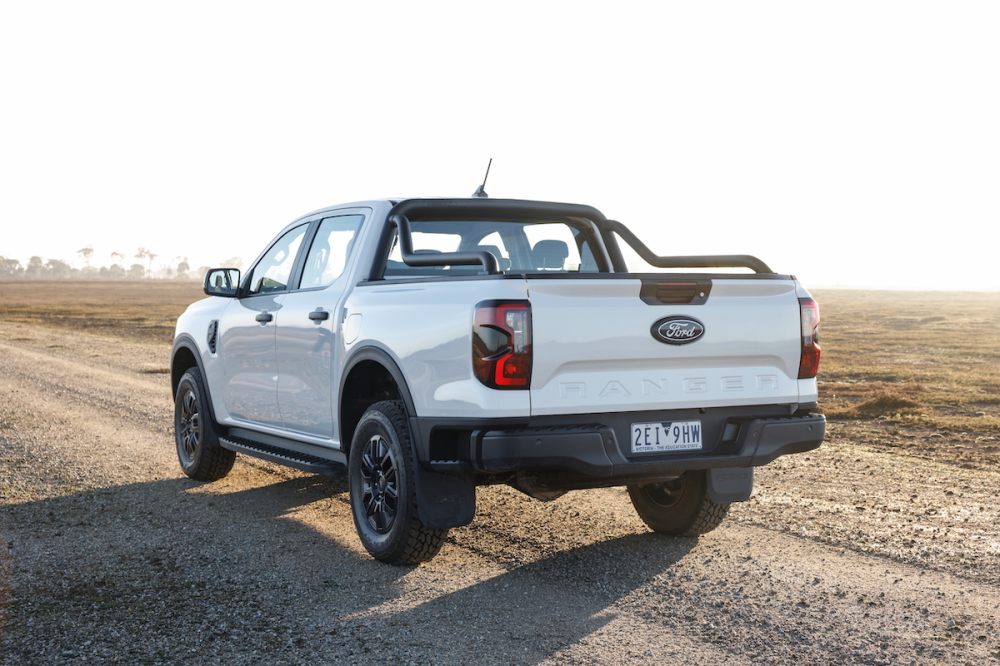
We also saw some seat time in the Tremor, Wolftrak, and Platinum variants. The Black Edition is a bit of an interesting proposition. Priced smartly at $53,000 drive away with the new four-pot of $60,000 drive away with the V6, it represents strong value.
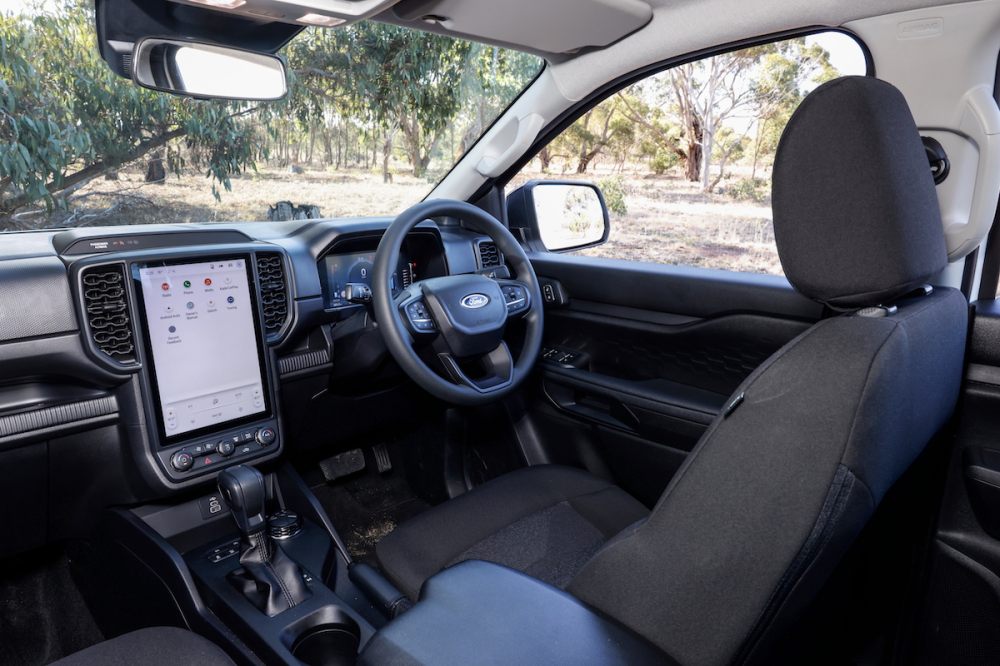
Despite its tough looks, it’s a rather basic specification though. Halogen headlights, cloth seats, and a basic polyurethane steering wheel might not be glossed over by the tough-looking wheels clad in all-terrains, depending on who’s buying it.
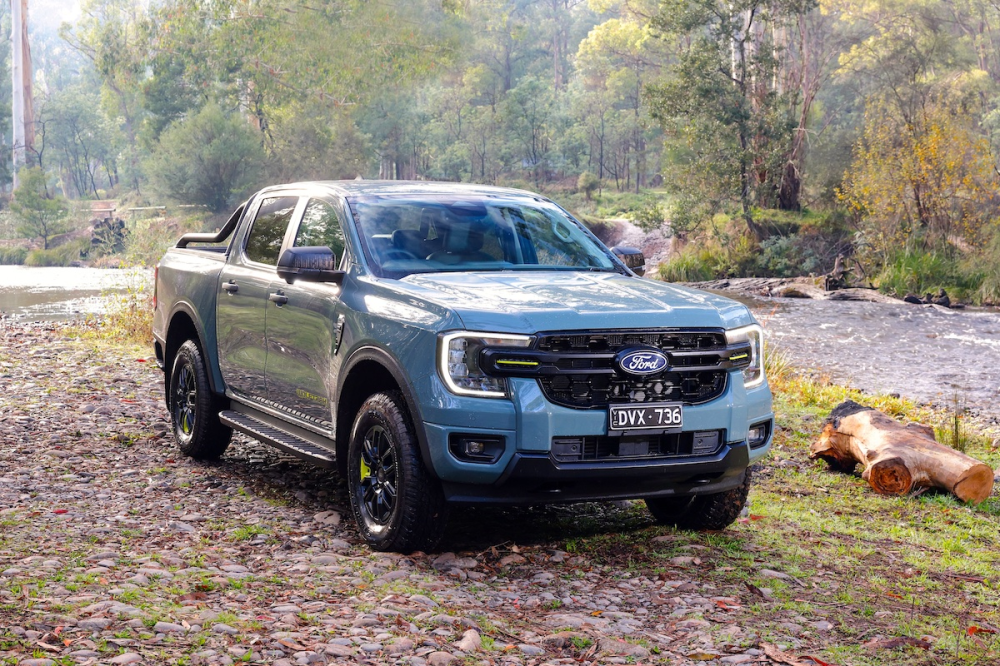
Mind you, it’s the best-specified four-cylinder model you’ll be able to get. Elsewhere, the new Wolftrak – priced at $73,000 drive away – stands out as rather a special thing. With its bright green decals, asymmetrical wheel inserts, and grille highlights, it’s a rather unmissable ute.
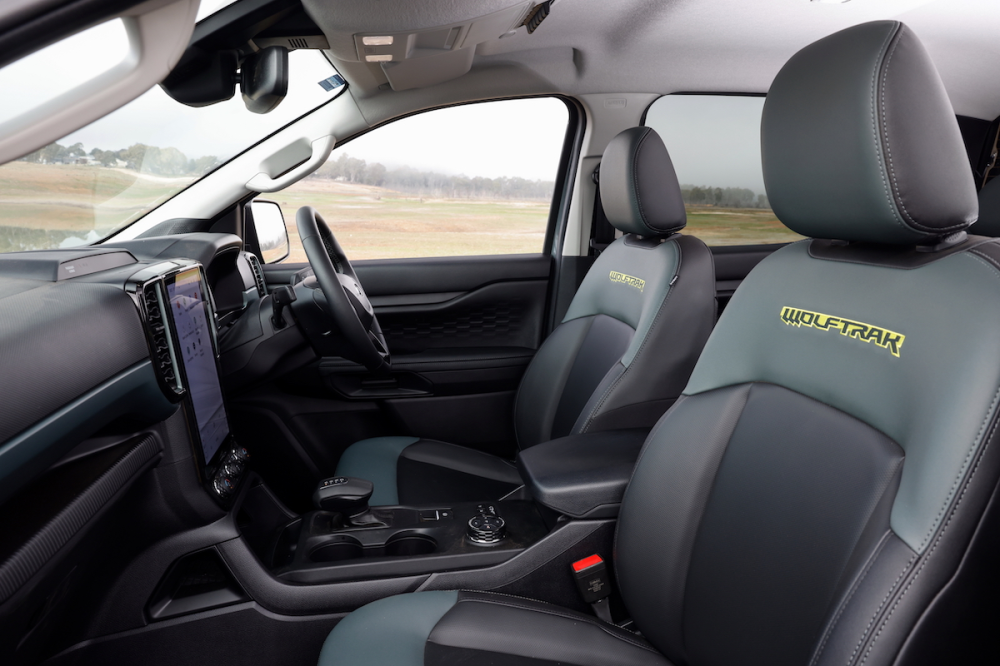
It’s a particularly good looker in Traction Green (as pictured), with that colour carried over on the inside with leather seat inserts and dashboard trim garnishes in a similar hue. That aside, visually, the Ranger is largely unchanged from before.
Some new wheel designs, black exterior trim where there used to be chrome, and the introduction of the latest iteration of the Ford logo are the most notable changes. That’s also the case on the inside, ignoring the Wolftrak’s fab cab.
The standardisation of the larger 12.0-inch SYNC infotainment display across the entire range is the only real point of note, but is something that’s another big boost for entry-level buyers. What really matters is how this thing drives on the road.
That's especially so for the new four-cylinder diesel engine. With just about every surface you could ask for at the You Yangs Proving Ground – including a ride and handling road, off road course, and banked high speed oval, there was no better place to test it.
Throw in a long drive on public roads back to the airport afterwards and we were spoilt for opportunities. What stands out immediately with the revised four-pot is how refined it feels. There’s no diesel engine clatter, emitting a muted note that easily fades into the background.
Power delivery is very smooth, with peak torque from 1750-2500rpm, allowing for excellent driveability. The 10-speed auto feels less fussy than in some other applications as well, and it does an excellent job of extracting more out of this engine than the numbers suggest.
Its ability to always keep it in the right spot in the power band means it does feel like it punches above its weight on paper, even if a bit more torque wouldn’t go astray. Most important, though, is the introduction of that timing chain.
One day isn’t long enough to know whether it has done the trick from a reliability perspective, but one can imagine Ford has spent plenty of time testing it themselves. Obviously, the Ranger is quite a known quantity on-road and off too.
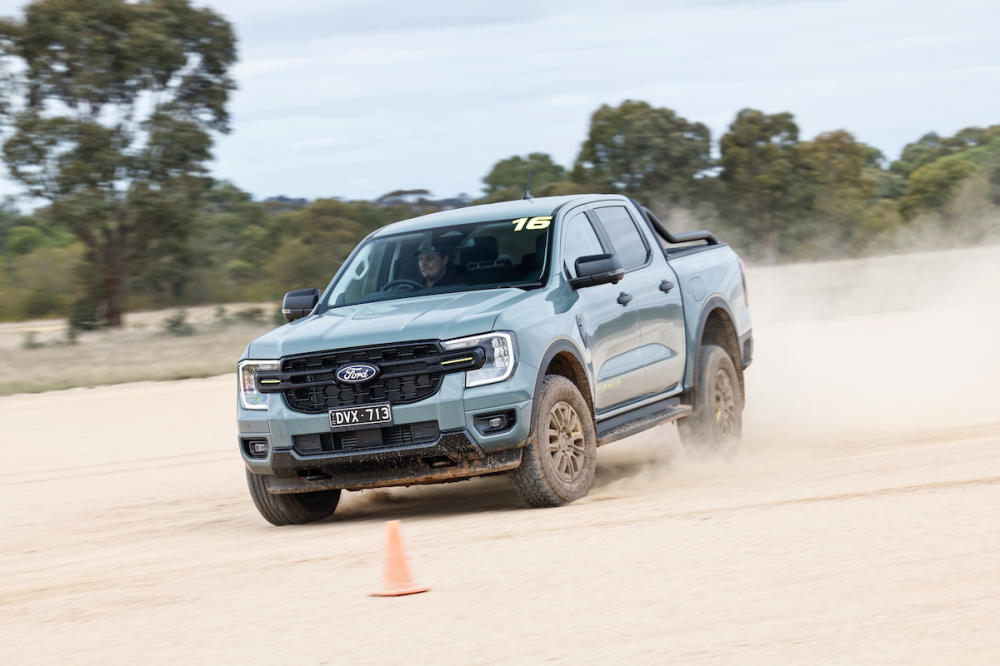
Its ride quality is still superior to the majority of utes; so too its handling. What did stand out among some of the off road driving activities however, mostly done in the V6-powered Tremor and Wolftrak, is how well calibrated its traction control and brake force distribution is.
That was never more evident than when performing high speed manoeuvres on loose surfaces. When getting the V6 out on the road though, there’s no ignoring how much stronger it feels than the four-cylinder, no matter how well tuned it is.
Little wonder the V6 is offered so widely across the lineup, including the base XL; its 600Nm force is indomitable. As before, the Ranger lineup is offered with a 5-year unlimited kilometre warranty. At the MY26.50 lineup’s launch, certain variants are also offered with a $4000 fuel card as an added benefit.
There are also drive away pricing offers on seven variants in the lineup. As the decimal point may well indicate, this update is a case of evolution rather than revolution for the Ranger. Perhaps unusually, the majority of meaningful benefits are aimed at buyers of entry level variants.
What stood out most at Ford's launch event was the opportunity to drive it where this platform was originally developed. It’s easy to see how clearly the Ranger was developed in, by, and for Australian conditions.
Our test vehicles were provided as part of a Ford Australia media launch event. This article first published on Exhaust Notes Australia.
Once you've found the right car, the next step is sorting out car finance that actually works for your budget. Credit One is Australia's best-reviewed finance broker, with 3,000+ five-star Google reviews from customers who've been through the process. Check out Credit One reviews to see what people say, or head straight to the loan repayment calculator to see what the numbers look like.